10.1.4How can area help?

The Integral Test

10-36.

Two improper integrals are shown below. With your team, determine which integral converges and which diverges, and give evidence that you are correct. Be prepared to share your evidence with the class.

  1. 11xdx 

  1. 11x2dx 

10-37.

Alex and Beatriz are comparing the infinite series A=n=11n and B=n=11n2. They conjecture that since integrals and infinite series are both ways to add an infinite number of terms, these series probably behave in the same way as the integrals in problem 10-36. That is, series A will probably diverge and series B will probably converge. However, their teammates are not convinced.

  1. On the Lesson 10.1.4 Resource Page, carefully plot the first six terms of series A and the first six terms of series B. Compare the corresponding terms on the graphs of each series. What do you notice?

  2. On the graph of series A, carefully sketch f(x)=1x for x>0. Likewise, on the graph of series B, carefully sketch g(x)=1x2 for x>0. What is significant about the values of f(1), f(2), and f(3)? What is significant about the values of g(1),g(2), and g(3)?

  3. Shade the regions under y=f(x) and y=g(x) to represent 11xdx and 11x2dx. Then sketch left endpoint rectangles, starting at n=1, to represent A=n=11n and B=n=11n2. Do the left endpoint rectangles yield a greater area or a lesser area than the integral?

10-38.

The Fundamental Theorem of Calculus gives us the tool to evaluate definite integrals, including improper integrals that diverge. Unfortunately, for most infinite series we do not have a tool to evaluate their sums. But, for certain series, analyzing its corresponding integral can help to determine whether it will converge or diverge.

  1. Return to the graphs of series A and series B from problem 10-37. Using a colored pencil, shade all regions that are contained by the rectangles but not the curves.
    In other words, shade RA=n=11n11xdx and RB=n=11n211x2dx.

  2. Explain why n=11n=11xdx+RA. Then use this equation to explain why this guarantees that series A diverges.

  3. Explain why the equation n=11n2=11x2dx+RB does not guarantee that series B converges.

  4. All is not lost for series B! With just one small manipulation, n=11n2=11x2dx+RB can demonstrate that series B converges.

i. On the graph for series B, imagine removing the first rectangle. Use sigma notation to represent the sum of the remaining rectangles.

ii. Even though you removed the first rectangle, infinitely many rectangles remain. Imagine shifting all of them one unit to the left. The resulting diagram can be used to justify that series B converges. Explain. 

iii. Will adding back the area of the first rectangle change your conclusion in part (ii)? Explain. 

10-39.

Copy and complete the statement below to write a conjecture that explains how improper integrals can be used to determine if an infinite series of decreasing terms converges or diverges.

The Integral Test

Let S=k=1ak with decreasing terms where f(n)=an and f is a continuous, positive, decreasing function over [k,)

If __________ is convergent, then S _____________.
If __________ is divergent, then S _____________. 

10-40.

Decide if each of the following infinite series converges. Justify your answers.  

  1. S=n=11nn 

  1. S=n=1nn+2 

  1. S=n=2ln(n)n 

10-41.

The series n=11n, which you examined in in problem 10-26, is known as the harmonic series because frequencies with whole numbers (such as 1:2,1:3,1:4,) are used in Western music.  In mathematics, harmonic series have many applications. One interesting thing is that n=11n is an example of a conditionally convergent series.

  1. Determine whether n=11n and n=1(1)n1n converge or diverge. Then state the tests you used to determine your answer.

  2. Use the results of part (a) to write a description for the term conditionally convergent.

  3. Think of an example of an absolutely convergent series.

10-42.
Revisit the list of infinite series in problem 10-2. Identify which series can be conveniently tested with the Integral Test. Then, for each series, use the Integral Test to determine if the series converges.

10-43.

Suppose that S=n=1an is a convergent series of non-negative terms. Explain why the series T=n=1ann will also converge. Homework Help ✎

10-44.

In a baseball game, as Barry hits a home run, Sammy leaves 1st base for 2nd base, running at 12 ft/sec. At the same time, Mark leaves 2nd base for 3rd base, running at 16 ft/sec. If the bases are 90 feet apart, at what amount of time after Barry hit the ball is the distance between Sammy and Mark at a minimum? What is the distance between them at that time? 10-44 HW eTool (Desmos). Homework Help ✎

10-45.

Examine the integrals below. Consider the multiple tools available for integrating and use the best strategy for each part. Evaluate each integral and briefly describe your method. Homework Help ✎

  1. ln(x+5)2x+10dx 

  1. 12y(3y)dy 

  1. eln(x)dx 

 d. 112xdx 

10-46.

Without your calculator, determine if each of the following integrals converges or diverges.Homework Help ✎

  1. 11x0.9dx 

  1. 11x1.1dx 

  1. 011x0.9dx 

  1. 011x1.1dx 

Compute without a calculator


10-47.

What is the unit vector that has the same direction as 8i6j? Homework Help ✎

10-48.

Without your calculator, determine the following limits. Homework Help ✎

  1. limx24(x2)33x6 

  1. limx4(x2)33x6 

  1. limx0xsin(x)ln(x+1) 

  1. limh0ln(xh)ln(x)h 

Compute without a calculator

10-49.

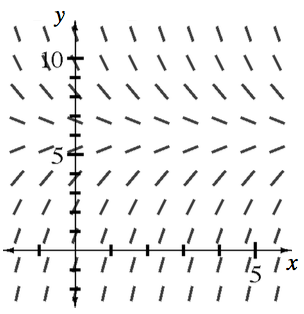
Match the differential equation dydx=y(6y) with its slope field. Explain your selection. Homework Help ✎

  1. Coordinate plane, 10 rows of 10 short segments, each row with same slope at given y values, as follows, @ negative 2.5, slope of 5, @ negative 0.75, slope of 5, @ 0.75, slope of 4, @ 2.5, slope of 3, @ 3.75, slope of 3 halves, @ 5.5, slope of 1 half, @ 6.75, slope of negative 1 half, @ 8.5, slope of negative 1, @ 9.75, slope of negative 2, @ 11.5, slope of negative 4. Your teacher can provide you with a model.

  1. Coordinate plane, 10 columns of 10 short segments, each column with same slope at given x values, as follows, @ negative 1.5, slope of negative 4, @ negative 0.75, slope of negative 2, @ 0, slope of 0, @ 0.75, slope of 2, @ 1.5, slope of 3, @ 2.25, slope of 4, @ 3.1, slope of 5, @ 4, slope of 5, @ 4.75, slope of 3, @ 5.5, slope of 1.

  1. Coordinate plane, 11 rows of 10 short segments, each row with same approximate slope at given approximate y values, as follows, @ negative 1.25, slope of negative 7, @ negative 0.5, slope of negative 6, @ 0.5, slope of 6, @ 1.25, slope of 7, @ 3.75, slope of 8, @ 5.25, slope of 8, @ 6, slope of 0, @ 6.5, slope of negative 3 halves, @ 8.25, slope of negative 8, @ 9.5, slope of negative 10, @ 10.25, slope of negative 10. Your teacher can provide you with a model.

10-50.

Jules wants to hang a garland in the shape of f(x)=2(x2+1)2 for 2x2 where x is measured in feet. How long does his garland need to be? Homework Help ✎